Certification

Advance your career with Academy certification

Academy certification is for dedicated, curious and hard-working strength and conditioning professionals. With an Academy certificate on your CV, you become the standard employers look for.

Apply for certification
Course & Assessment

Course, assessment and certificate

A structured pathway from understanding anatomy to assessing movement, designing training and refining coaching practice.

What the course covers

  1. Glute and lower-body anatomy

    Study the gluteus maximus, medius and minimus alongside the thigh muscles. Relate hip extension, abduction and rotation to the pelvis, knee, ankle and foot.

  2. Glute shape and training assessment

    Establish a repeatable baseline using training history, consented standardised photographs, circumferences and movement observations. Distinguish appearance, movement performance and individual goals.

  3. Movement screening and exercise adjustment

    Observe range, control and tolerance during squats, hip hinges, lunges and single-leg tasks. Adjust stance, load, range and coaching cues; select progressions, regressions or referral when appropriate.

  4. Anatomy-led targeted glute training

    Use anatomy and biomechanics to guide hip thrusts, bridges, squats, hip hinges and hip abduction. Compare hip angles, resistance direction and stability while examining the limits of regional targeting.

  5. Lower-body programming and reassessment

    Select exercises, volume, load, repetitions, effort and recovery around individual goals and experience. Track performance, apply progressive overload and revise the programme using reassessment.

  6. Practical coaching and case application

    Practise equipment setup, demonstrations, feedback and individual adaptations. Explain decisions through assessment records and case work; distinguish acute EMG responses from long-term training outcomes.

Assessment

  1. Theory and reasoning

    Explain functional anatomy, training variables, assessment methods and research evidence, including the rationale for exercise selection and programme design.

  2. Observed practical coaching

    Demonstrate safe setup, exercise instruction, observation, feedback and adaptations. Evaluate practical competence through observed coaching performance.

  3. Assessment and programming case

    Present a case covering baseline, goals, programme, training records and reassessment. Justify changes and recognise situations outside the coaching role.
Targeted training means selecting exercises for a clear anatomical and movement goal. It does not imply that every point can be isolated or that a single exercise guarantees a particular glute shape.

Assessment guides exercise selection; photographs alone do not establish a diagnosis. Persistent pain or suspected injury requires an appropriately qualified healthcare professional.

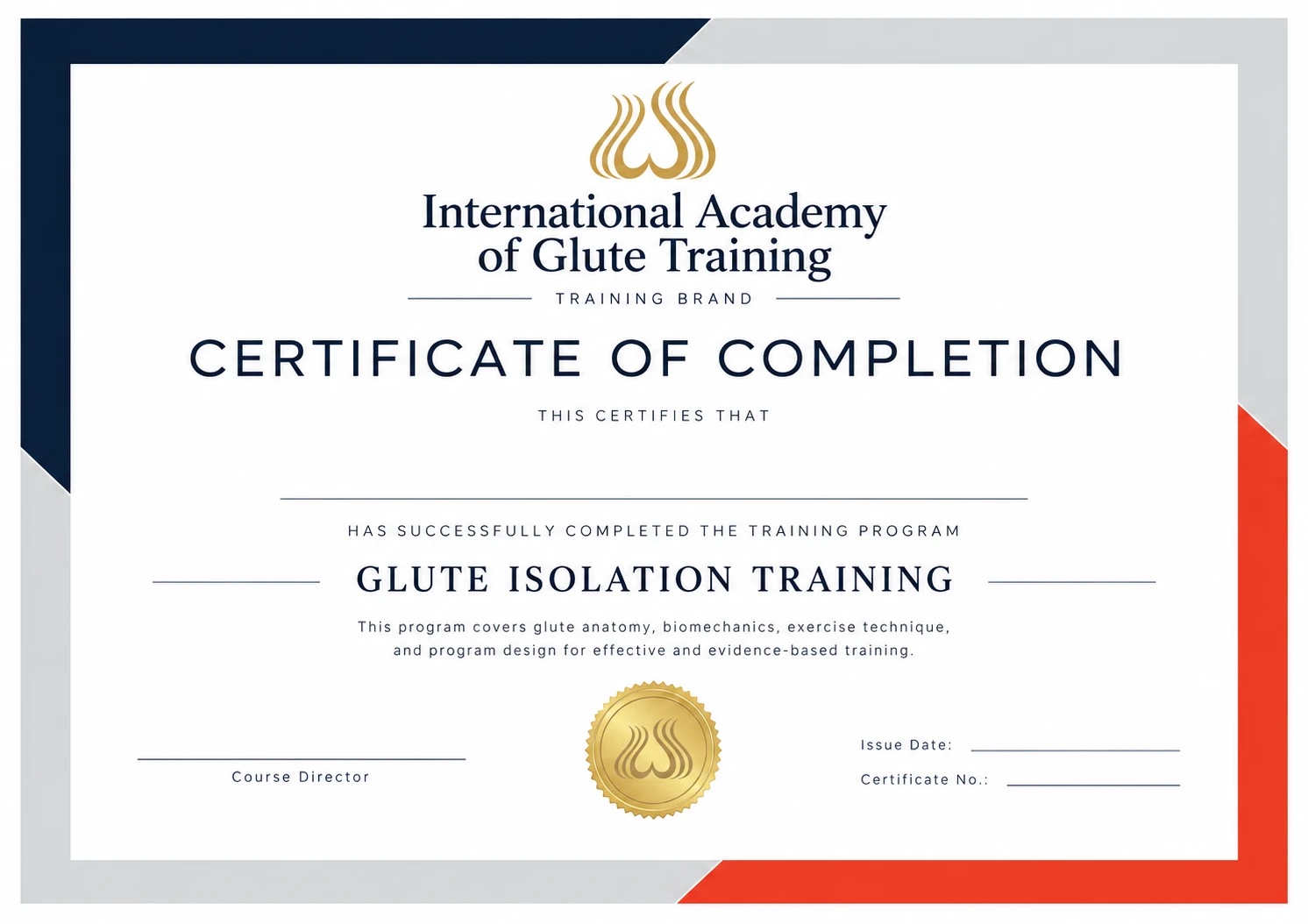
Sample certificate of completion

Learn glute training systematically. Sharpen your coaching.

Built on exercise anatomy and biomechanics, the course covers glute training principles, exercise coaching and program design. Meet the completion requirements to receive a certificate of completion in English or Chinese.

  • Issued in English or Chinese, recording your course completion
  • Lists the certificate number and course details for easy verification
  • States training hours and issue date, so you can show your learning

How it works

  1. Step 1

    Apply

    Contact the Academy to apply.

  2. Step 2

    Study

    Complete the certification course and library.

  3. Step 3

    Assessment

    Pass the certification assessment.

  4. Step 4

    Certified

    Receive your bilingual certificate, verifiable online.

Number format: IAGT 00000001 — IAGT followed by eight digits.

Start your professional glute training education

Structured courses, a professional library, assessed certification and career resources.

Start learning